88. Black-and-White Tile Border
You have an even number of identical square tiles. Exactly half of them are black and the other half are white.
You arrange all the tiles to form one large rectangle subject to the following rules:
- The black tiles form a solid inner rectangle of size a × b.
- The white tiles form a border that is exactly one tile thick on every side of that black rectangle, completely surrounding it.
No tiles are left over. How many tiles could you have in total?
Submitted by tartle · Added 15 October 2008 · Updated 12 July 2026
Hint: Write equations: the number of black tiles is ab; the number of white tiles equals the area of the outer rectangle minus the inner one. Then use the fact that there are equally many black and white tiles.
Solution:
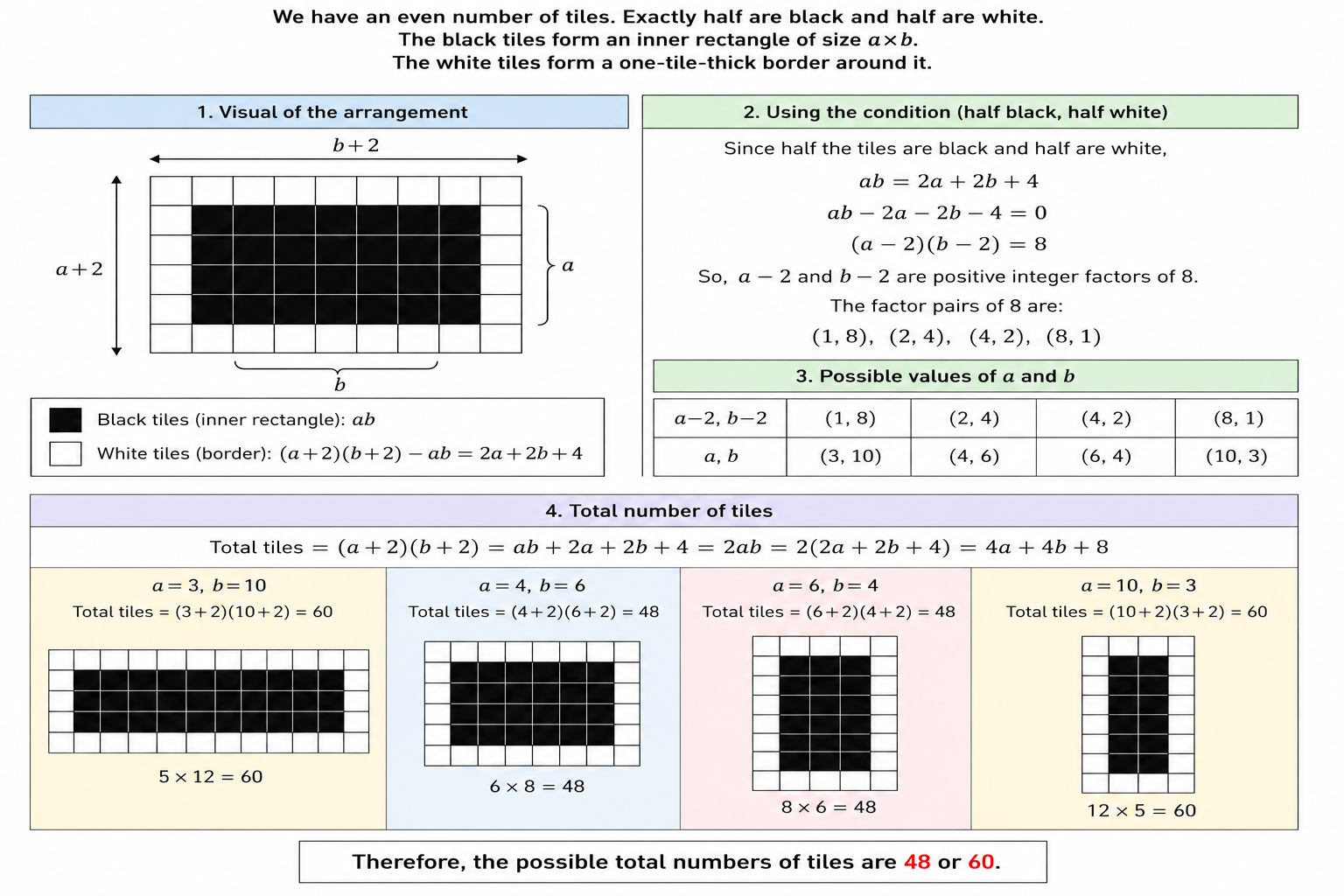
Let the inner black rectangle have dimensions a × b (with a, b > 0). The outer rectangle, including the white border of one-tile thickness, has dimensions (a+2) × (b+2).
Black tiles: ab
White tiles: (a+2)(b+2) − ab = 2a + 2b + 4
Because there are equally many black and white tiles,
ab = 2a + 2b + 4.
Rearranging gives
(a − 2)(b − 2) = 8.
The positive integer factor pairs of 8 are (1, 8), (2, 4), (4, 2) and (8, 1), yielding
- a = 3, b = 10 or a = 10, b = 3 → ab = 30 black, 30 white ⇒ 60 tiles in total;
- a = 4, b = 6 or a = 6, b = 4 → ab = 24 black, 24 white ⇒ 48 tiles in total.
Therefore the arrangement is possible with either 48 tiles or 60 tiles altogether.


Comments (0)
No comments yet. Be the first!
Add a Comment or Suggest an Answer